
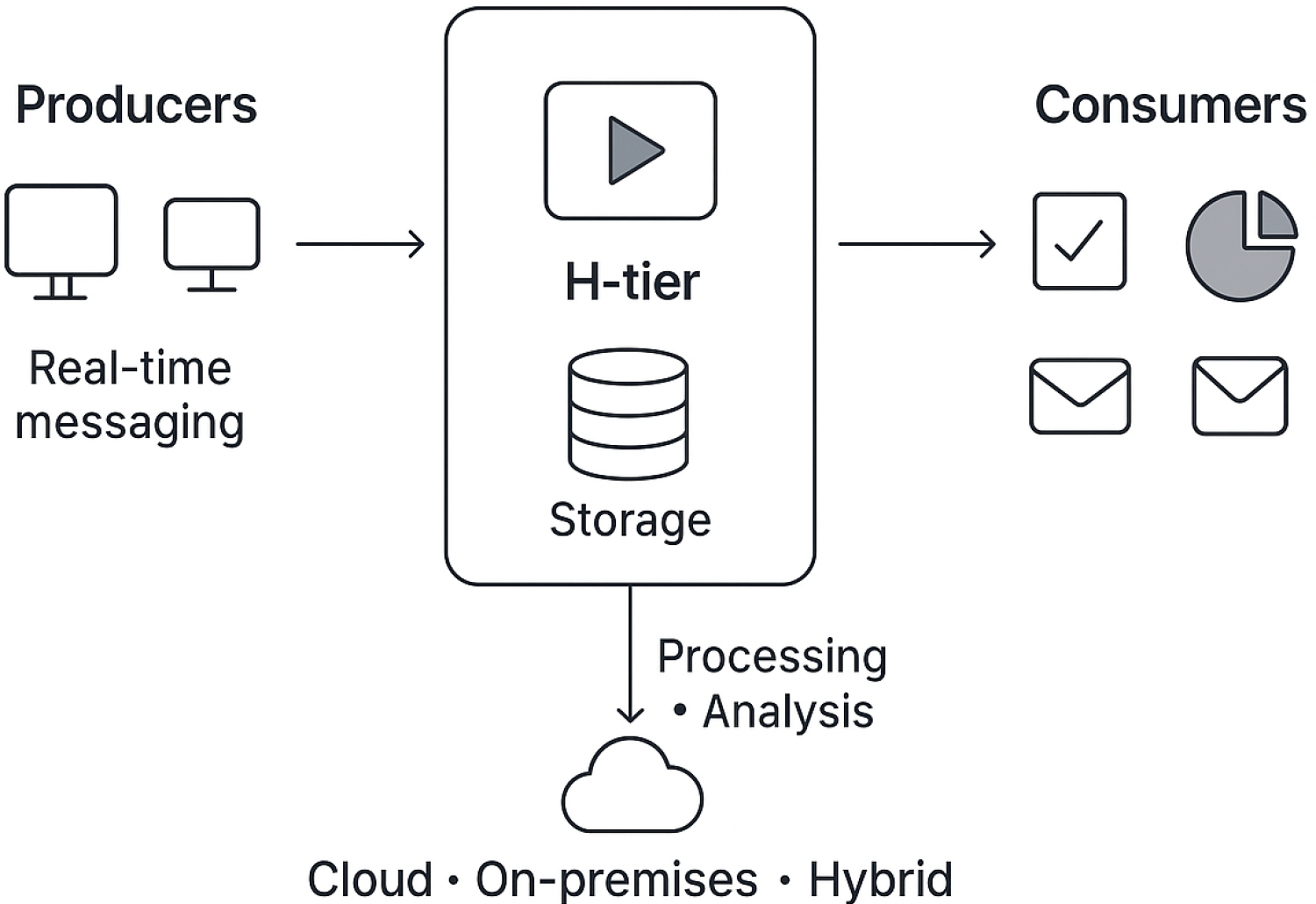
What is Htier?
Htier is a platform that helps you move, store, and process real-time data. Think of it as a high-speed messaging and data pipeline that lets different parts of your business talk to each other — instantly, reliably, and at scale.
-
With Htier, you can:
- Send and receive real-time messages (called events) between systems.
- Store those events safely for as long as you need.
- React to or analyze those events — either immediately or later.
Htier is built to handle massive amounts of data, keep running even if some parts fail, and scale easily as your needs grow. You can run it in the cloud, on your own servers, or in a mix of both.
A Quick Example: What Does a Data Stream Look Like?
-
Let’s say you run an online store. Here’s how Htier might help you:
- Scenario: A customer places an order
-
Event Created
Your website creates an event when Alice buys something:
- Key: Alice
- Value: Bought item #123 for $59.99
- Timestamp: Sep 25, 2025 at 3:42 PM
- Event Sent to Htier Topic This event is sent to a topic called “purchases”.
-
Other systems respond instantly:
- 📦 Inventory is updated
- 💳 Billing system logs the charge
- 📊 Analytics dashboard shows new sale
- ✉️ Email system sends Alice a receipt
All these systems are consumers of the same event stream — meaning they automatically get the information and can act on it, without needing to contact each other directly.
And since Htier stores events safely, you can also go back and reprocess this data later — great for reports, audits, or fixing issues.
What Makes Htier Special?✅ Built with Rust
-
Htier is developed in Rust, a modern programming language known for:
- Speed – Rust is extremely fast and efficient
- Safety – Rust prevents many common bugs and errors
- Reliability – Systems built in Rust are more secure and crash-resistant
By choosing Rust, the developers of Htier made performance, safety, and stability a core part of the platform. That’s why Htier is a great fit for mission-critical systems where data loss or downtime isn’t an option.
How Does Htier Work?
-
Htier has two main parts:
- 1. Servers: These store your data and manage connections to other systems. Some focus on storing event data (called brokers), while others help move data in and out of Htier from systems like databases or other apps (via Htier Connect). Htier is fault-tolerant — if one server goes down, others take over automatically to keep things running.
- 2. Clients: These are applications that send and receive events. You or your developers can use ready-made tools in popular programming languages like Java, Python, Go, C++, or Rust itself. You can also connect using simple REST APIs.
Key Terms (Explained Simply) 🧾 Event
-
An event is just a record of something that happened.
Example:
- “Alice bought item #123 for $59.99”
- A key (who/what it's about)
- A value (what happened)
- A timestamp
- Optional details (headers)
Events include:
- Producers send events to Htier
- Consumers read and process events from Htier
- They don’t need to know about each other — Htier handles the delivery.
📨 Producers & Consumers:
- Events are organized into topics, like folders.
- Example: All purchase events go into a topic called “purchases”.
- Topics can have many producers and many consumers — it's a flexible system.
📂 Topics:
- Each topic is split into partitions (like buckets), spread across servers. This allows:
- Faster performance
- Scalable data handling
- Guaranteed ordering of related events
- Events with the same key (e.g. "Alice") always go to the same partition, and consumers read them in the exact order they were written.
🪣 Partitions:
- ⚡ Real-time: Move data instantly between systems
- 💾 Reliable: Data is safe even if systems crash
- 📊 Re-processable: Replay or analyze data at any time
- 🌍 Flexible: Run it anywhere — cloud, on-prem, or hybrid
- 🦀 Rust-powered: Built for speed, safety, and stability from the ground up
Why Choose Htier?
-
Final Thought
Whether you’re syncing systems, analyzing real-time data, or building automation across your business, Htier gives you a powerful, modern platform — all built on the speed and safety of Rust.